

I build one of the tools on this list. That's the disclosure, sentence one, so you can calibrate everything that follows. It's also why this ranking might be worth your time: I've spent this year benchmarking coding agents on real merged bug fixes with each agent on its own API key, so several of the numbers below come off an actual provider bill, not a vendor slide.
Two rules for this list. Mine doesn't get the top spot. Vendors crowning themselves #1 is the fastest way to be worth ignoring. And every entry gets a genuine "pick it when," because all ten of these tools are someone's right answer.
How this is ranked
Four things, in order. Does it fix real bugs (where I have head-to-head data, I cite it), do you know what it costs (self-reported spend vs the provider's console, which disagree more than you'd think), how it understands your codebase (a persistent index, an ephemeral one, or fresh grepping every session), and how much freedom you keep (models, editors, exit costs).
What this list is not: a feature checklist. Everything here edits multiple files, runs tests, and calls tools. In 2026 that's the floor, not the ceiling.
The table
| # | Agent | Where it runs | Codebase understanding | Models | Price |
|---|---|---|---|---|---|
| 1 | Claude Code | terminal | agentic search, no index | Anthropic only | sub or API |
| 2 | Empryo | terminal + desktop | persistent code graph | 22 providers | free · BYOK |
| 3 | Cursor | own IDE | embeddings, rebuilt ~6 weeks | multi | from $20/mo |
| 4 | GitHub Copilot | VS Code, GitHub | repo-aware, cloud | multi | from $10/mo |
| 5 | OpenCode | terminal | LSP diagnostics only | multi + Zen | free · BYOK |
| 6 | Cline | VS Code | deliberately no index | BYOK | free · BYOK |
| 7 | Codex CLI | terminal | agentic search | OpenAI | ChatGPT plan |
| 8 | Devin Desktop | own app | cloud index | managed | subscription |
| 9 | pi | terminal | none — minimal harness | multi | free · BYOK |
| 10 | Aider | terminal | repo map (the original) | multi | free · BYOK |
1. Claude Code — the default
The tool the rest of the category is measured against, and that's earned. Anthropic ships the models *and* the harness, so new capabilities land here first, and the hooks + MCP + subagent ecosystem is the deepest in the field. Its bet is that a strong model with fast agentic search beats any index. No embeddings, no graph, just very good grepping every session. On large monorepos you pay for that bet in re-exploration tokens, and you're locked to Anthropic models. It's still the safest recommendation on this page.
Pick it when: you live on Claude models anyway and want the largest ecosystem with zero setup.
2. Empryo — mine, so here's the case with receipts, not adjectives
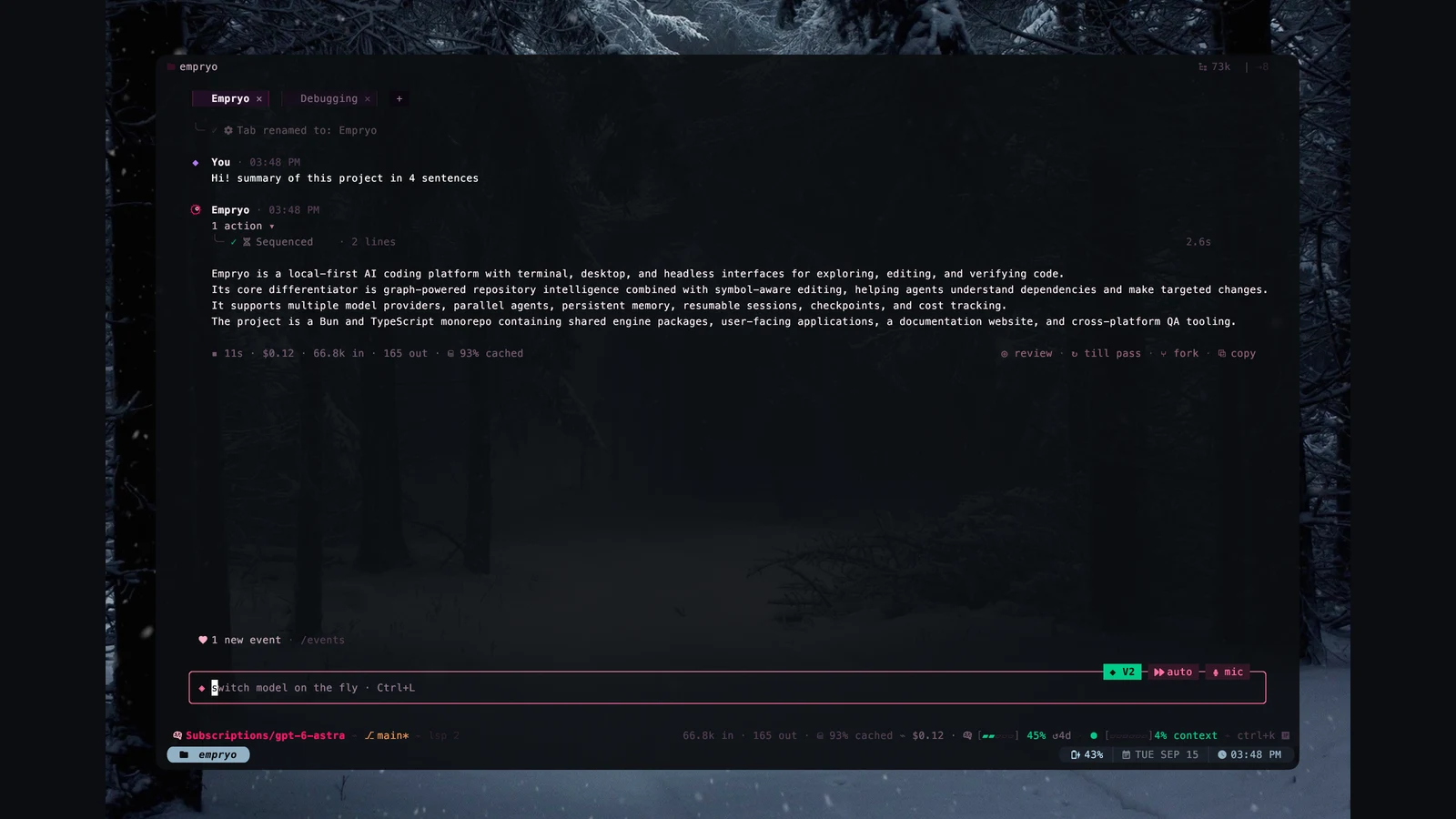
By the four criteria above, mine earns this spot, and because I built it you should demand evidence, not enthusiasm. So, the ledger: in head-to-head benchmarks on real merged bug fixes, each agent on its own API key so Anthropic's console is the judge rather than my telemetry, Empryo fixed 8/9 vs 7/9 and 7/10 vs 6/10, at −28% and −23% billed cost and up to −57% wall clock. In every audit, Empryo's self-reported spend matched the console to the cent; the competition's missed by up to 32%. It is the only tool on this list whose ranking claims you can re-run yourself for the price of two API keys.
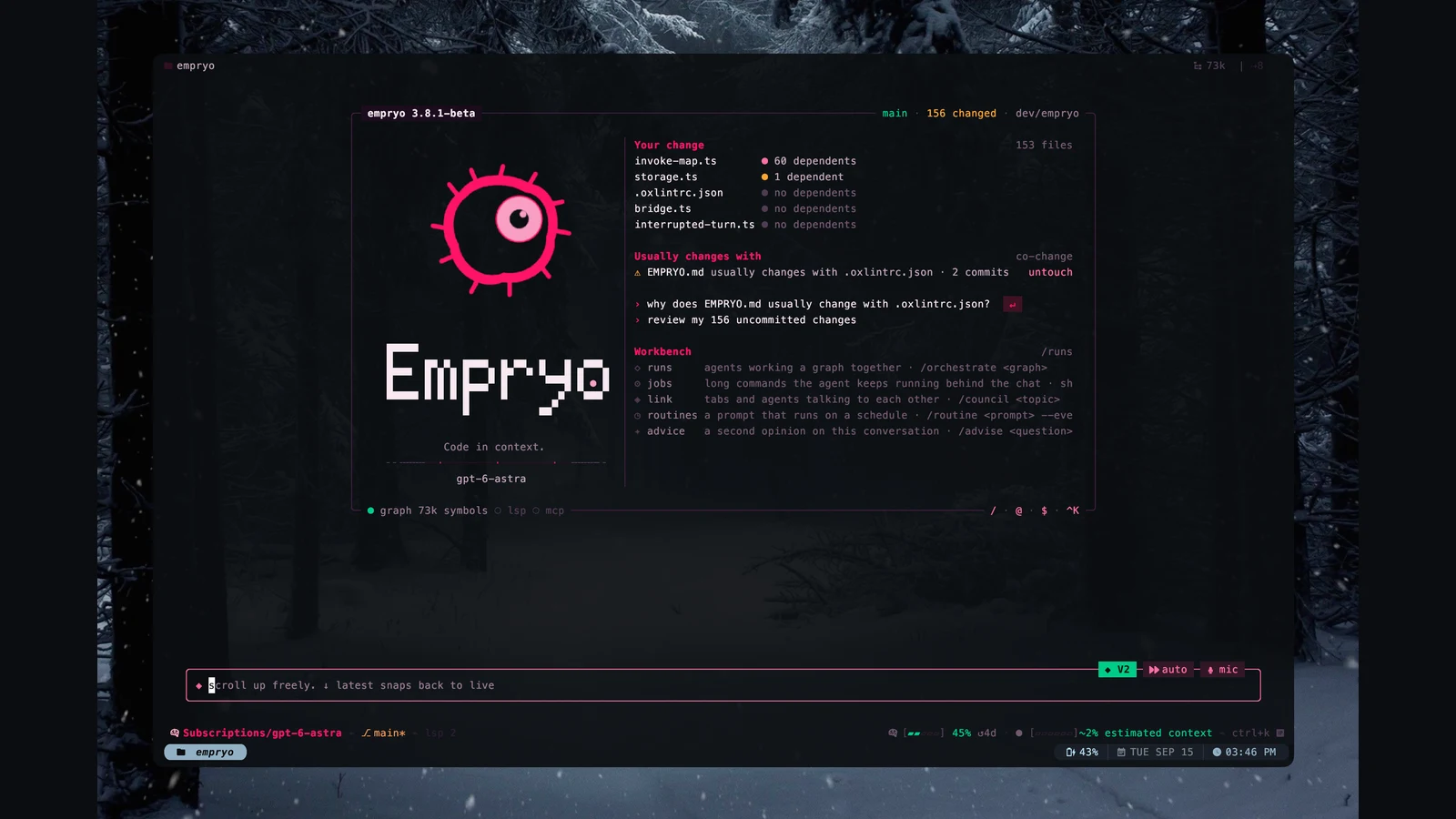
There's no magic in it. A persistent ranked code graph (the Genome) means the model starts every session already holding a map of your codebase instead of re-grepping it. That's why Haiku with the graph fixed bugs that otherwise needed Opus, at a fifth of the cost. Edits go through the AST and LSP: symbols, not strings. Cost, speed, and fix rate are where Empryo is loudest; polish is where it's still earning. See "where mine loses" below, and note it hasn't faced #1 head-to-head yet. That round is coming.
Pick it when: you want measured performance per dollar, meaning an agent cheap enough to run all day that already knows your codebase when the session starts.
3. Cursor — the IDE
If your center of gravity is an editor rather than a terminal, Cursor is the most polished answer. Composer is genuinely fast, tab-completion is still the one to beat, and the embeddings index gives it decent recall on medium codebases. Two honest caveats: that index is ephemeral, rebuilt roughly every six weeks per their own docs, so it's recall rather than accumulated understanding; and you're adopting a whole IDE, which is exactly what you want or exactly what you don't.
Pick it when: you want the best AI-native editor experience and a subscription price you can predict.
4. GitHub Copilot — the distribution play
Copilot wins on being everywhere your code already is. Agent HQ turned it into a real multi-agent surface, AI Credits made the billing legible, and for teams already on GitHub Enterprise the procurement conversation is one sentence long. It is nobody's most *capable* agent, and the ceiling is lower than the tools above it, but the floor is high, the integration is frictionless, and for a lot of teams that trade is correct.
Pick it when: your org is on GitHub and "already approved by security" is worth more than peak capability.
5. OpenCode — the open-source terminal favorite
The most popular open-source terminal agent, and the community momentum is real. The TUI is excellent, Zen gives you at-cost model access with no markup, and the provider surface is broad. Its code intelligence is thinner than the tools above it (LSP for diagnostics, no persistent index), so on large codebases it explores more and remembers less. But as a free, hackable, well-maintained daily driver, it's an easy tool to like.
Pick it when: you want an open-source terminal agent with a big community and at-cost model pricing.
6. Cline — the transparent one
Cline's whole philosophy is "no magic": open source, bring your own key, watch every step, approve every action. It deliberately builds no index, and their own blog argues against it, which makes it predictable and auditable, and also means it re-reads your codebase every session. The plan/act split is the best workflow feature nobody else copied properly. For teams that need to *see* what the agent does before trusting it, this is the honest choice.
Pick it when: auditability beats autonomy and you want full visibility into every model call and file touch.
7. Codex CLI — the OpenAI answer
Open-source, terminal-native, and the cleanest way to point OpenAI models at your repo, especially if a ChatGPT plan you already pay for covers it. It moves fast and the sandboxing story is thoughtful. It's below the top tier because codebase understanding is session-scoped agentic search, and the harness is still visibly younger than Claude Code's ecosystem.
Pick it when: you're on OpenAI models and want their first-party agent rather than a third-party wrapper.
8. Devin Desktop — the autonomy bet
The former Windsurf, now carrying Cognition's flag. The pitch is delegation rather than collaboration: hand off a ticket, review a PR. When the task is well-scoped, it's genuinely impressive; when it isn't, you review a lot of confident wrong answers. The rename and re-platforming cost it community trust this year, which is why it sits here despite real capability.
Pick it when: you want to delegate whole tickets and are set up to review agent PRs like a colleague's.
9. pi — the minimalist
pi is a deliberate rejection of everything above: a few thousand tokens of harness, a handful of tools, no index, maximum model freedom. I've benchmarked against it twice, so I'll say plainly: it's well built, its author is serious, and on tasks where raw model quality dominates, the minimal harness costs surprisingly little. Its one real gap in my testing was cost visibility — its self-reported spend missed a crashed session's tokens that the console still billed.
Pick it when: you believe harness weight is the enemy and want the thinnest possible layer over the model.
10. Aider — the pioneer, in maintenance
Aider invented half of what this category takes for granted: the repo map, git-native commits per change, scripting-first design. It's in maintenance mode now, with commits slowed for most of a year, which is the only reason it's last. It still works, it's still free, and its ideas live on in most tools above it (including mine — the Genome is a direct descendant of the repo-map idea, with a ranking engine grown on top).
Pick it when: you want the most battle-tested scriptable workhorse and don't need the newest anything.
Where mine loses
Honesty section. Empryo is in public beta and built by one person part-time, so several tools above ship faster than I do. No IDE plugin: if you live in VS Code, Cursor or Cline fit your hands better today. The Genome needs a scan on first launch — seconds on most repos, but Claude Code starts colder faster. And Claude Code's ecosystem of hooks, MCP servers, and community skills is something a solo project simply doesn't match yet.
Check my math
Every number I cited is reproducible: the benchmark harness, tasks, and raw results are public. Two API keys and one command re-runs the whole thing. If your bill disagrees with mine, open an issue — that's a bug report I'll take seriously.
To test a shortlist on your own code, use our coding-agent comparison worksheet. It covers acceptance tests, retries, review time, and complete costs.
*Updated July 17, 2026. This list gets revisited as the category moves, and in 2026 it moves monthly.*
 Compare AI coding agents on your own repository
 What is an AI agent harness? Follow one code change
 I stopped building panels and let you morph the app